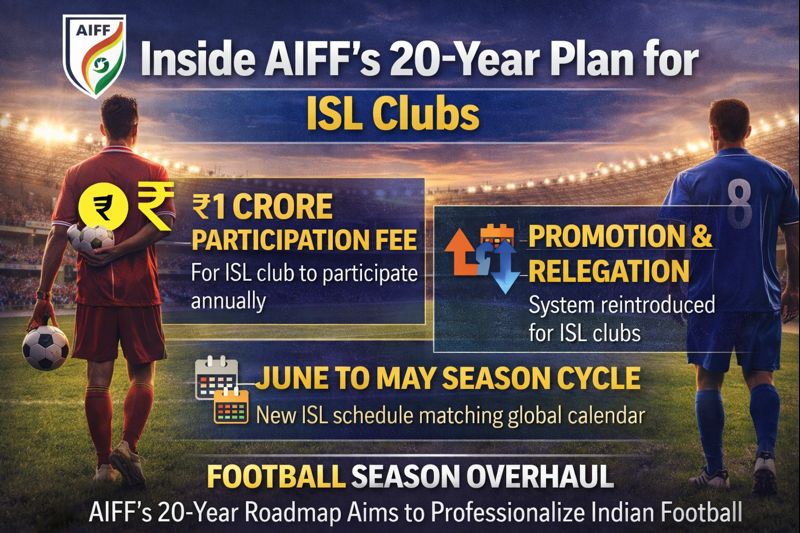
The All India Football Federation (AIFF) has prepared a long-term 20-year roadmap to strengthen Indian football and make the Indian Super League (ISL) more competitive and sustainable. This plan focuses on financial discipline, a proper league structure, and alignment with global football standards. Key highlights include a ₹1 crore participation fee for ISL clubs, the return of promotion and relegation, and a June to May season cycle.
The governing body’s proposal comes days after it rejected the clubs’ blueprint, where they recommended to own the league. The latest suggestion comes following a meeting of the committee in charge to come up with a solution to kick-start India’s stalled domestic season — comprising AIFF and ISL club officials — on Friday.
Mandar Tamhane, the chief executive of John Abraham-owned NorthEast United, said the AIFF’s proposal laid a ‘solid foundation’ for further talks. The clubs and the federation will meet again in New Delhi on Monday, December 29
“What they have proposed is something the clubs will now discuss internally. Following that, we will get back to the AIFF to fine tune the proposal. There will be a lot of discussions, but prima-facie this lays solid foundation to build something concrete,” Tamhane told
The federation, in its suggestion, said they would keep 10 per cent of the total revenue share — down from the 14 per cent proposed by the Football Sports Development Limited (FSDL) in their plan to renew the deal. Since the ISL came into existence in 2014, it was owned and operated by the FSDL, a Reliance Industries subsidiary. Their deal with the AIFF expired on December 8 and did not submit an official bid when the AIFF floated a tender to find a commercial partner.
Under their plan, the AIFF said the first season of the renewed ISL would run with an operational budget of Rs 70 crore. Every club, it added, would pay a ‘standard participation fee’ of Rs 1 crore annually. This amount, the federation added, would be ‘reimbursed’ from the central revenue pool. The league’s governance, it said, would be handled by a board with limited autonomy, while AIFF would retain final financial control. The structure also preserves promotion and relegation to protect sporting merit.
However, concerns remain over costs, player salary caps, investment security, and the continued uncertainty around the ISL 2025–26 start date. There are concerns also over broadcast partners and quality, given that Star Sports was a co-owner of the ISL until the agreement expired.